Full Stack Python Course in 2026 are expected to handle every part of a web application, from user interfaces to server logic and data management. Today’s development environment expects programmers to be comfortable working with different parts of a project, including user interfaces, server logic, and data handling.
Companies now prioritize practical ability—developers who understand how different components connect and function together.
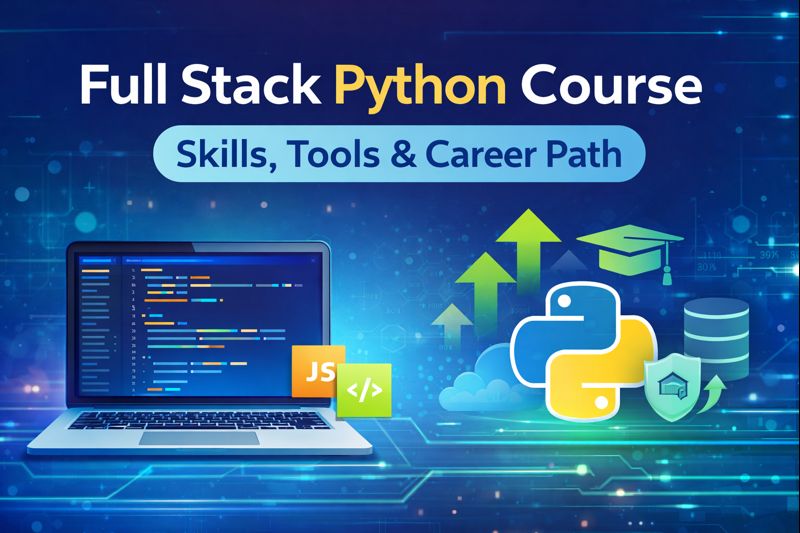
Python plays a key role in this change due to its simple syntax and wide ecosystem. When combined with modern frontend tools and cloud-based platforms, it allows developers to create complete, scalable software solutions. As a result, businesses prefer hiring adaptable professionals instead of managing multiple specialists for each layer of development.
This roadmap is designed for beginners starting from scratch as well as professionals looking to strengthen their technical foundation. It outlines the skills, tools, and learning steps required to become a confident, job-ready Python Full Stack Developer in 2026 through the right full stack python course and hands-on practice.
Why Python Full Stack Is a Smart Career Choice in 2026
Python has maintained its dominance due to its readability, scalability, and deep integration with AI, automation, and data-driven applications. In full stack development, Python enables developers to work on robust backends while seamlessly supporting modern frontend frameworks.
A practical full stack python course equips you to handle the complete development lifecycle—from user interface design to database management and deployment—making you highly employable across startups, SaaS companies, and enterprise teams.
Step 1: Frontend Skills Every Full Stack Developer Needs
Even in a Python-driven stack, frontend skills are non-negotiable.
Core Technologies
- HTML5 for semantic structure
- CSS3 for responsive layouts (Flexbox & Grid)
- JavaScript (ES6+) for interactivity
Modern Frontend Tools
- React for dynamic UI development
- Tailwind CSS or Bootstrap for faster styling
A quality full stack python course teaches frontend development with backend integration in mind, not as a disconnected skill.
Step 2: Python Fundamentals & Backend Development
Backend development is the backbone of the Python full stack role.
Python Core Skills
- Data structures and algorithms
- Object-Oriented Programming
- Exception handling and modular code
- Asynchronous programming basics
Backend Frameworks to Learn
- Django for secure, scalable applications
- FastAPI for high-performance APIs and modern microservices
Most updated full stack python course programs in 2026 emphasize FastAPI alongside Django due to performance and API-first architectures.
Step 3: Databases & Data Handling
Modern applications rely heavily on efficient data storage and retrieval.
Must-Know Databases
- PostgreSQL / MySQL for relational data
- MongoDB for NoSQL use cases
You should also understand:
- Database design principles
- ORM tools (Django ORM, SQLAlchemy)
- Query optimization
Hands-on database projects are a core component of any serious full stack python course.
Step 4: APIs, Authentication & Backend Integration
In 2026, most applications are API-driven.
Essential Skills
- REST API development
- JWT-based authentication
- OAuth and role-based access control
- Third-party API integration (payments, emails, analytics)
This is where a full stack python course moves from theory to real-world readiness.
Step 5: DevOps Basics & Deployment Skills
Companies now expect developers to understand how applications go live.
Tools to Learn
- Git & GitHub for version control
- Docker for containerization
- Cloud platforms (AWS, Azure, or Vercel basics)
- CI/CD fundamentals
Deployment experience significantly boosts the value of a full stack python course on your resume.
Step 6: Real-World Projects (The Hiring Decider)
Projects are what recruiters care about most.
Recommended Project Types
- Full-stack CRUD application
- Authentication-based platform
- Admin dashboard
- API-driven SaaS application
A strong full stack python course ensures you build multiple real-world projects that demonstrate both frontend and backend expertise.
Career Path After Completing a Full Stack Python Course
Typical roles include:
- Python Full Stack Developer
- Backend Developer (Python)
- Web Application Developer
Salary Outlook (2026)
- Freshers: ₹5–10 LPA (India)
- Mid-level developers: ₹12–20 LPA
- Global opportunities offer significantly higher packages
How to Choose the Right Full Stack Python Course
Before enrolling, ensure the full stack python course offers:
- Project-based learning
- Updated frameworks (FastAPI, modern React)
- Deployment and DevOps exposure
- Mentorship or career guidance
Final Thoughts
Becoming a Python Full Stack Developer in 2026 is not about learning everything—it’s about learning the right skills in the right order. A structured roadmap combined with a well-designed full stack python course can take you from beginner to job-ready faster than scattered self-learning.
Focus on practical projects, modern tools, and real-world problem solving, and you’ll be well-positioned to succeed in today’s competitive tech market.