
How to Rank in Google AI Overviews is the most critical SEO skill in 2026 as Google shifts from blue links to AI-generated answers. Search has entered a new phase. In 2026, ranking on Google is no longer just about blue links or even featured snippets. The real visibility battle is happening inside Google AI Overviews—the AI-generated summaries that appear at the very top of search results. If your content is not being referenced or cited there, you are invisible to a growing percentage of users.
Understanding How to Rank in Google AI Overviews requires a mindset shift. You are no longer optimizing only for users or algorithms separately—you are optimizing for AI systems that summarize the web on behalf of users. As someone who has worked in SEO and Digital Marketing for over a decade, I can confidently say this is the biggest change since mobile-first indexing.
Let’s break down what actually works.
Why Google AI Overviews Changed SEO Forever
Google AI Overviews are designed to answer queries instantly. Instead of sending users to ten different pages, Google’s AI (powered by advanced models like Gemini) synthesizes information from multiple trusted sources and presents one consolidated answer.
That means ranking #1 is no longer enough.
To succeed, you must become the source of truth the AI trusts.
This is the core principle behind How to Rank in Google AI Overviews.
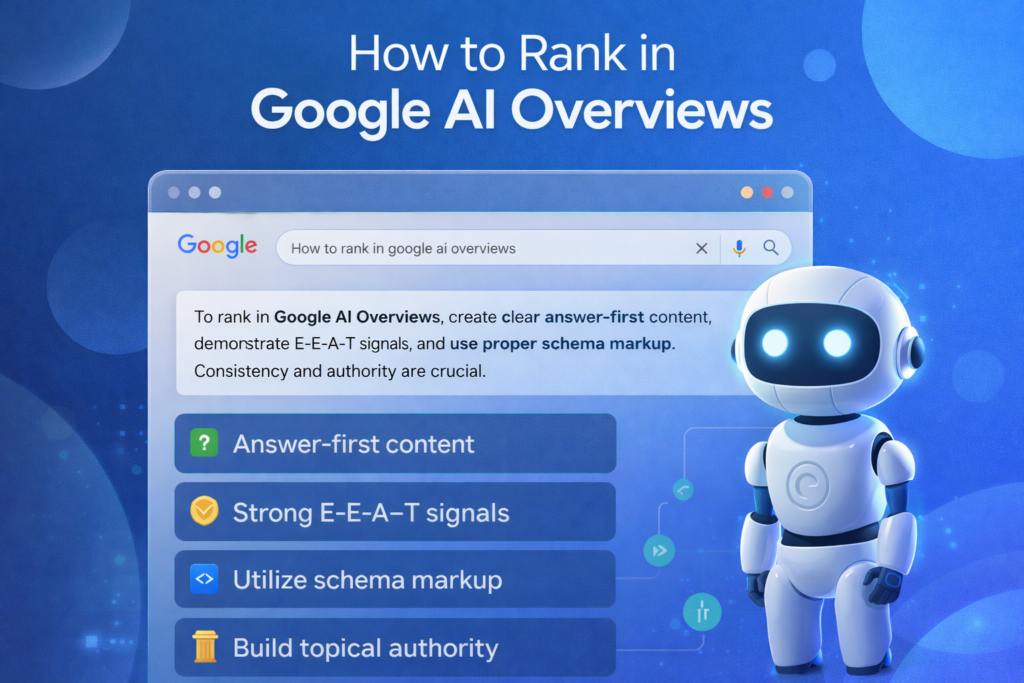
Use an Answer-First Content Structure (Non-Negotiable)
AI Overviews favor clarity over creativity. If your key insight is buried deep in the article, the AI will skip it.
Start every major page or section with a direct 40–60 word answer that clearly explains the topic. This opening should:
- Directly answer the search intent
- Use simple, factual language
- Include the primary keyword naturally
This answer-first structure helps Google extract your content easily for AI summaries while still serving human readers. In Digital Marketing terms, think of this as optimizing for zero-friction consumption.
Write for Questions, Not Just Keywords
One of the most overlooked aspects of How to Rank in Google AI Overviews is query framing.
AI Overviews are triggered more often by:
- “How to” questions
- Comparisons
- Problem-solving searches
- Multi-part, conversational queries
Your headings should mirror how people actually ask questions today. Use H2s and H3s like:
- “How does Google choose sources for AI Overviews?”
- “What content format works best for AI summaries?”
This helps AI systems map intent, context, and relevance—far more important than keyword repetition.
Build Topical Authority, Not Isolated Pages
Single blog posts don’t win AI Overviews. Authority does.
Google’s AI evaluates whether your website consistently covers a topic in depth. That’s why topic clusters matter more than ever in SEO and Digital Marketing.
To improve your chances of ranking:
- Create a pillar page (like this one)
- Support it with 5–10 related articles
- Interlink them logically
- Cover definitions, use cases, benefits, tools, and future trends
When Google sees comprehensive coverage, it treats your site as a reliable reference—ideal for AI citations.
Prove Real Experience (E-E-A-T Is Stronger Than Ever)
In 2026, AI-generated content is everywhere. Google knows this—and actively filters it.
To rank in Google AI Overviews, your content must show real human experience:
- First-hand insights
- Practical examples
- Observations from actual SEO or Digital Marketing campaigns
- Clear author attribution with credentials
This is where many sites fail. AI can rewrite content, but it cannot replace genuine experience—and Google rewards that distinction.
Make Your Content Easy for AI to “Read”
Formatting is not cosmetic anymore; it’s strategic.
Use:
- Short paragraphs (2–3 lines)
- Bullet points for steps
- Tables for comparisons
- Clear H1–H3 hierarchy
- FAQ-style sections
Structured data like FAQ schema or HowTo schema further improves extraction. You’re essentially speaking the AI’s language while still writing for humans.
Final Thought: AI Visibility Is the New SEO KPI
Learning How to Rank in Google AI Overviews is no longer optional—it’s a core SEO skill. Brands that adapt early will dominate visibility, authority, and trust. Those who rely on old tactics will slowly disappear from the conversation.
The future of SEO and Digital Marketing isn’t about tricking algorithms.
It’s about clarity, structure, experience, and usefulness—delivered better than anyone else.
If you become the clearest and most reliable voice on a topic, Google’s AI will choose you.